

Today’s buildings are designed or modernized to achieve a high level of performance and energy efficiency. Energy modeling, optimized control sequences, rigorous commissioning—everything is in place to deliver high-performance buildings.
However, a building that performs well at a given point in time does not automatically remain efficient over the long term. Its use evolves, operational adjustments accumulate, and its HVAC equipment ages. Initial performance gradually drifts until the impacts become noticeable.
It is in this context that approaches such as Recommissioning (RCx) and Monitoring-Based Commissioning (MBCx) become highly relevant. They make it possible to optimize a building over different time horizons: one acts on a one-time basis, while the other is designed for long-term continuity.
RCx and MBCx: From One-Time Intervention to Continuous Energy Monitoring
The recalibration of mechanical systems, or Recommissioning (RCx), is now a well-known approach. It consists of carrying out, in a structured but one-time manner, a series of analyses, verifications, and interventions to optimize the operation of HVAC systems and improve building energy efficiency.
In practical terms, the building is analyzed at a given point in time, performance gaps are identified, and the necessary corrective measures are implemented. This approach is effective and often makes it possible to achieve quick gains. However, it improves the situation at a specific moment, without guaranteeing that this performance will be maintained over time.
Monitoring-Based Commissioning (MBCx) introduces a different approach. It is a continuous process of analysis and optimization based on the building’s operational data. System behavior is monitored over time, performance drift is detected early, and adjustments are made on an ongoing basis.
A simple analogy :
RCx is like a snapshot.
 MBCx is like a video.
In summary, RCx aims to improve performance during a given period, while MBCx aims to ensure that performance is maintained continuously. MBCx also serves as ongoing support for operations teams, facilitating decision-making and improving their understanding of issues related to complex systems. It can also be seen as continuous training based on real-world cases.
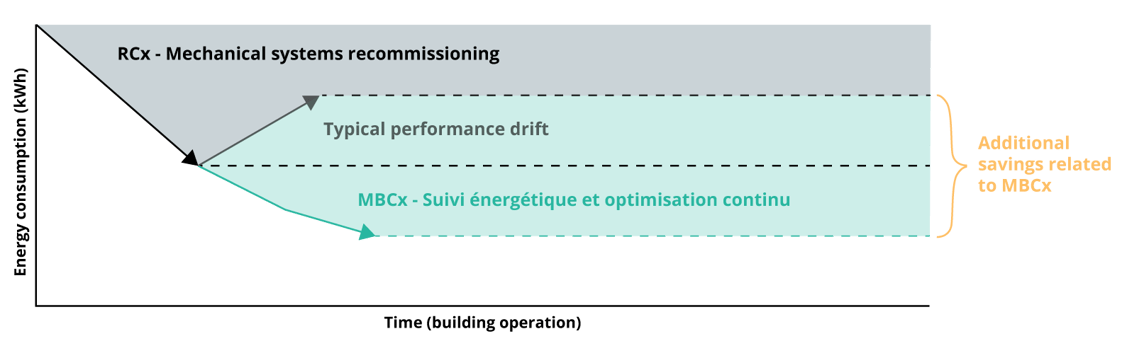
Evolution of a building’s energy consumption during operation: after recommissioning (RCx), performance gradually drifts without ongoing monitoring, whereas an MBCx approach helps stabilize performance and generate additional energy savings.
Why Does Building Performance Drift Over Time?
In a context where HVAC systems are becoming more complex and operational resources are limited, maintaining building performance is a significant challenge. A building does not become inefficient overnight. It drifts gradually, until the impacts become visible.
Several factors can affect performance:
-
Setpoint adjustments or overrides implemented to address one-off issues, such as comfort complaints, special events, or equipment failures, that are not documented or tracked over time.
-
Changes in building use or occupancy, such as schedules or density, without corresponding adjustments to control strategies.
-
Natural equipment wear and tear.
-
An incomplete understanding of system operation, leading to adjustments that move away from the original design intent.
-
Control sequences that have become inadequate in relation to actual operating conditions.
Individually, these factors may seem minor. Over time, however, they lead to performance drift and several symptoms begin to appear: comfort complaints, energy overconsumption, repeated interventions, inconsistent system operation, and even premature equipment failures.
As systems move further away from optimal control sequences, the frequency of problems increases, creating a vicious cycle in which performance drift fuels problems, and those problems further amplify the drift.
What Are Your Options for Maintaining Performance?
As these performance drifts take hold, you generally face several options.
- The first is to intervene reactively: respond to complaints and correct problems once they become visible. Although necessary, this approach is often costly and inefficient over the long term, since it does not address the root causes of performance drift. It also leads to a partial view of the issues, where attention is focused on an isolated piece of equipment without considering its role within the overall system or its interactions with other equipment.
- The second option is to carry out a structured process over a defined period, such as a recommissioning project. This makes it possible to correct a range of issues and restore a satisfactory level of performance. However, once the process is complete, and in the absence of continuous monitoring, performance drift reappears over time.
- The third option is to adopt a proactive strategy based on continuous performance monitoring. This is where MBCx becomes particularly relevant. By relying on the building’s operational data, MBCx makes it possible to detect deviations as soon as they appear and to intervene in a targeted way before they generate more significant impacts. This approach introduces a key concept for building managers: avoided costs.

The Economic Benefits of MBCx—and Its Operational Impacts
In practice, observed gains generally range from 10% to 20% in energy savings, and can occasionally reach up to 40%, depending on the building’s initial condition. Beyond measurable savings, other benefits are also observed:
-
Fewer comfort complaints.
-
Less time spent managing emergencies.
-
More efficient use of equipment, helping extend its service life.
Rather than absorbing energy overconsumption, repeated interventions, or premature equipment wear, it becomes possible to limit these impacts by acting upstream. To make this approach possible, one element becomes central: access to data and its structured use. This is precisely the role played by the Building Management System (BMS).
The BMS: A Key Tool for Supporting an MBCx Approach
The Building Management System plays a central role in an MBCx approach. It acts as the convergence point for data by centralizing information from HVAC equipment, sensors such as temperature, humidity, and CO₂ sensors, and the building’s various systems, such as lighting.
It makes it possible to monitor performance continuously, analyze system operation, and identify deviations or optimization opportunities.
The BMS can also serve as an integration platform, facilitating interoperability with external sources such as energy data, current and forecast weather data, and specialized analytics tools, in order to obtain a more comprehensive view of performance.
However, it is important to note that the BMS alone does not guarantee an MBCx approach. It is the structured use of data, combined with continuous analysis and corrective actions, that allows its full value to be realized.
Building controls specialists use the BMS as both a monitoring tool and a lever for action. In particular, they can:
-
Quickly implement measures and evaluate their impacts.
-
Adjust setpoints and operating parameters.
-
Identify new energy-saving opportunities.
-
Track key indicators using graphs and alarms configured according to specific rules.
Where Should You Start?
Implementing an MBCx approach does not require transforming everything from the outset.
A good starting point is to:
-
Target two or three critical systems, such as ventilation, heating, or cooling.
-
Define a few simple indicators, such as energy consumption, after-hours operation, temperature drift, or simultaneous heating and cooling.
-
Analyze the data already available in the BMS.
-
Correct the most obvious drifts by adjusting setpoints, sequences, and/or schedules.
-
Measure the results and make further adjustments.

The buildings that benefit most quickly from MBCx are often:
-
Buildings that have recently modernized their control systems.
-
Buildings with recurring complaints or high energy consumption.
-
Buildings whose control sequences have evolved without structured follow-up.
-
Buildings with complex systems, such as heat recovery, geothermal systems, energy storage systems, etc.
Real-World Cases of Performance Drift Detected Through MBCx
An MBCx approach makes it possible to identify anomalies that may otherwise go unnoticed for long periods.
The following are concrete examples that have been observed, along with the impacts that were avoided:
-
Observed issue: A kitchen system was kept in 24/7 operation to compensate for discomfort. The exhaust hood and make-up air unit therefore operated continuously, even during winter. → Avoided impact: A significant increase in heating demand caused by unnecessary outdoor air intake.
-
Observed issue: Nearly 300 ventilation units in a shopping centre started simultaneously every morning with heating demand caused by night setback. → Avoided impact: Major power peaks that would have resulted in demand charge penalties over the year.
-
Observed issue: A snow-melting system was activated in the middle of summer due to inadequate control logic. → Avoided impact: Energy waste.
-
Observed issue: A heat pump was controlled solely based on supply air temperature. → Avoided impact: Frequent start-stop cycling causing premature equipment wear.
-
Observed issue: High-performance energy recovery units delivered limited efficiency due to an inadequate operating mode. → Avoided impact: Lost energy savings.
-
Observed issue: Faulty or poorly calibrated CO₂ sensors. → Avoided impact: Systems unnecessarily increasing outdoor air intake, thereby increasing heating and cooling loads.
Maintaining Building Performance Over Time: Key Takeaways
- Today’s buildings are designed to be efficient, but their performance cannot be taken for granted over time.
- Performance drift refers to the gradual gap between the building’s intended performance and its actual performance.
- RCx makes it possible to optimize a building at a given point in time, while MBCx makes it possible to monitor and improve performance continuously.
- The BMS is a central tool, not only for understanding building behavior, but above all for acting proactively and maintaining achieved gains.
- Moving from a reactive approach to an MBCx approach means transforming the way costs are generated: from incurred costs to avoided costs.
- In practice, design teams are rarely exposed to the actual behavior of buildings once they are in operation. MBCx helps reveal the gaps between the performance targeted during design and the reality in the field, creating a concrete opportunity for engineers and architects to improve the design of future projects.
By integrating an MBCx approach, you take back control of your building’s performance.
Contact us to learn more.
To Go Further
Since this article has piqued your interest, continue your visit by browsing our most viewed articles.


.jpg?width=1150&height=874&name=blog-petra%20(1).jpg)